
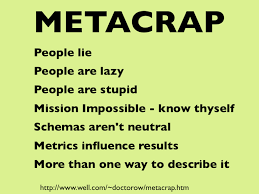
During the course of writing last week’s post, I found a post about “the seven straw men of metautopia”. This post does a great job of describing the common problems inherent in delivering valuable metadata – as summarized below
Table of Contents
Introduction
In the realm of information organization, metadata serves as the cornerstone of efficient retrieval and analysis. Metadata, often referred to as “data about data,” encompasses elements such as keywords, titles, abstracts, and categorizations. In recent times, explicit human-generated metadata has gained prominence, particularly within the context of technologies like XML. The allure of creating a metadata-rich landscape promises a utopian vision of seamless information exploration and discovery.
However, a deeper examination reveals that the road to this meta-utopia is laden with challenges and complexities that deserve our attention. This discourse delves into the inherent hurdles that undermine the realization of a fully functional metadata-driven paradigm.
Obstacles Ahead
Dishonesty
In a competitive environment, where attention and engagement are prized commodities, metadata can easily be manipulated. Whether it’s the deliberate inclusion of misleading keywords or deceptive descriptors, the landscape of metadata becomes tainted when self-interest prevails. An honest pursuit of comprehensive and accurate metadata becomes compromised when ulterior motives enter the equation.
Laziness
While some diligently craft meticulous metadata, many users approach this task with casual indifference. The gap between metadata enthusiasts and the average user’s lackadaisical approach is substantial. This gap is exacerbated by users who neglect to label files and documents effectively, resulting in a fragmented and disorganized information landscape.
Cognitive Limitations
The ideal of consistently precise metadata falters when faced with the complexity of human cognition. People often struggle to objectively categorize and describe their own creations, leading to inconsistencies and inaccuracies. This limitation in self-awareness undermines the reliability of user-generated metadata.
Self-Understanding
Expecting individuals to objectively evaluate and categorize their own creations ignores the intricate interplay of subjectivity and perception. The concept of accurate self-assessment, integral to the meta-utopian ideal, clashes with the reality of human bias and ego.
Biased Schemas
The notion of universally agreed-upon categorization schemes oversimplifies the intricate nature of diverse interests and motivations. In practice, competing viewpoints result in the emergence of multiple, conflicting schemas that cater to specific agendas and priorities. The battle for dominance among these schemas undermines the very notion of a neutral and universal metadata hierarchy.
Influence of Metrics
Adopting standardized metrics to evaluate and rank information introduces an unintended bias towards particular attributes. The prioritization of certain metrics may inadvertently marginalize valuable content that doesn’t align with those metrics. The delicate balance between relevance and metrics distorts the integrity of metadata-driven results.
Diverse Descriptions
Language and perception’s intricate nuances result in diverse ways of describing the same subject. Attempting to enforce a singular vocabulary for metadata disregards the richness of interpretation and expression. Homogenizing descriptions stifles creativity and authentic representation.
Navigating the Terrain
The Role of Metadata
While the meta-utopia remains elusive, metadata remains an indispensable tool in the information landscape. By acknowledging its limitations and embracing its potential, we can make informed assumptions and streamline information retrieval processes.
Harnessing Observational Metadata
Observational metadata, derived from objective sources like link structures and user behaviors, holds promise as a more reliable form of information assessment. This approach, as demonstrated by search engines like Google, mitigates the influence of subjective biases and self-promotion.
The Power of Implicit Endorsement
Implicit endorsement, whereby the popularity and relevance of content are gauged by its observed reception, provides a more organic and trustworthy indication of value. Recognizing the weight of collective judgments over individual metadata creation offers a path towards a more reliable and inclusive information ecosystem.
Conscus
In conclusion, the quest for a meta-utopia must navigate through a complex landscape of human behavior, biases, and limitations. As we reconcile the inherent challenges of metadata, we discover alternative approaches that leverage observational insights and implicit endorsement, paving the way for a more informed and comprehensive understanding of the digital realm.
Metacrap: Putting the torch to seven straw-men of the meta-utopia
The post was written in 2001 and referred to website metadata.
Yet in many cases, these same challenges are inherent in any metadata project. What examples can you come up with for each of these in your business?
 Data Quality Matters
Leave a comment