John O’Gorman’s comment on last week’s post deserved its own post
I’ve added my own comments below his (Solution 2)
First: A couple of caveats from him
The internet is out of bounds for now. These seven only apply to the enterprise – a big enough challenge in its own right.
Next, metadata is only one form, or I should say Function of a string of Data. All the other functions, like master data, reference data, transaction data, structured data and unstructured data are covered under this rubric.
Finally, forget about technology: this is, as correctly pointed out by the author, a cultural thing.
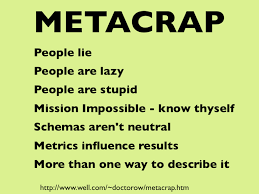
1. People lie
Solution: Don’t ask them to tell the truth. Give them instead guidelines that show them that lies will be tolerated but not perpetuated.
Solution 2: Validate with a group. Metadata should not be done by one person
2. People are lazy
Solution: Don’t ask them to do anything. If they do nothing, they don’t get paid.
Solution 2: Make it as easy as possible. The less obtrusive metadata harvesting and maintenance is the more likely it is to be done.
3 People are stupid
Solution: Make it possible to connect any kind of stupid (misspellings, abbreviations, acronyms, etc.) to standard spelling.
Solution 2: Nothing to add here. Flexibility and forgiveness are critical
4 Mission: Impossible — know thyself
Solution: Say what’s true for you and let the wisdom of the crowd validate. Or not.
Solution 2: Also applies to problem 1
5 Schemas aren’t neutral
Solution: – Don’t use a schema until you’ve figured out the language first.
Solution 2: And allow flexibility once you define a schema. How easily can you change as your truth changes
6 Metrics influence results
Solution: – Don’t use hierarchies until you’ve figured out the language first. As the author points out, if you have to pick just one everyone else is miserable.
7 There’s more than one way to describe something
Solution: Yes, there is. Thank goodness.
Solution 2: Context is important. If you have two valid (but conflicting) descriptions can they be placed in different contexts?
Thanks, John for your great insights. We are busy with the deployment of a data catalogue at a major South African bank and these are some of the problems and solutions that we are seeing
 Data Quality Matters
Leave a comment