In today’s fast-paced and data-driven world, the ability to trust the data in your business systems is paramount. Just as we seek trust and evidence in our daily lives, businesses must ensure the integrity of their data to make informed decisions, comply with regulations, and gain a competitive edge. This article explores the challenges of trusting data and how data lineage, metadata, and innovative solutions like Safyr can help you achieve that trust.

The Need for Trust in Data
In the late nineties, as the Business Intelligence (BI) market gained momentum, a pivotal question arose: “How do I know that’s a real number?” This query came from a user staring at variance numbers flashing red on their dashboard. What they craved was not just the final figure but an understanding of how it was generated. They needed to trace its origins, transformations, and calculations.
Back then, meeting such demands was a considerable challenge. Users yearned for a simple right-click or hover-over feature to access this critical information. Today, thanks to advancements in data governance, automated data lineage and data catalogue solutions, these needs can be more readily met. Businesses recognize that compliance hinges on accurate and timely reporting, making data trustworthiness paramount.
The Role of Metadata
In an era where fake news and questionable advertising run rampant, our awareness of the importance of trustworthy information has heightened. We’re encouraged to focus on leveraging metadata, which acts as a beacon of authenticity. In the media world, details like the date and time of a picture or the precise location of a video enhance trust in their validity.
But how can we instil the same level of trust in enterprise data? To achieve this goal across the entire data landscape, we must address a significant challenge: Enterprise Resource Planning (ERP) systems.
The Challenge of ERPs
ERPs, initially rooted in the manufacturing sector, have evolved into comprehensive systems that automate processes across various industries and departments. Mainstream enterprise software providers like SAP, Oracle, and Microsoft recognized the potential of ERPs to streamline operations. Today, running a competitive enterprise demands constant ERP maintenance.
Despite housing a treasure trove of data, ERPs present unique challenges:
- Lack of Original Design: ERPs weren’t originally designed to be open systems, hindering accessibility.
- Complex Data Models: They consist of large, complex, customized, and opaque data models that defy easy interpretation.
- Limited Metadata Tools: ERPs offer scant tools for data analysts to analyze, subset, and share metadata.
Considering that a typical SAP implementation may involve over one hundred thousand tables, it’s no surprise that data professionals often grapple with where to begin. Consequently, projects encounter delays and cost overruns. However, there’s a solution.
Unlocking ERP & CRM Metadata with Safyr
Certain categories of software, like data discovery tools, have evolved to be vendor-agnostic. Among these, Safyr stands out as a product specifically designed to analyze, curate, and share ERP & CRM Metadata comprehensively. It goes beyond scanning and lifting metadata; it connects and interprets critical business and technical metadata sources, fostering trust in data.
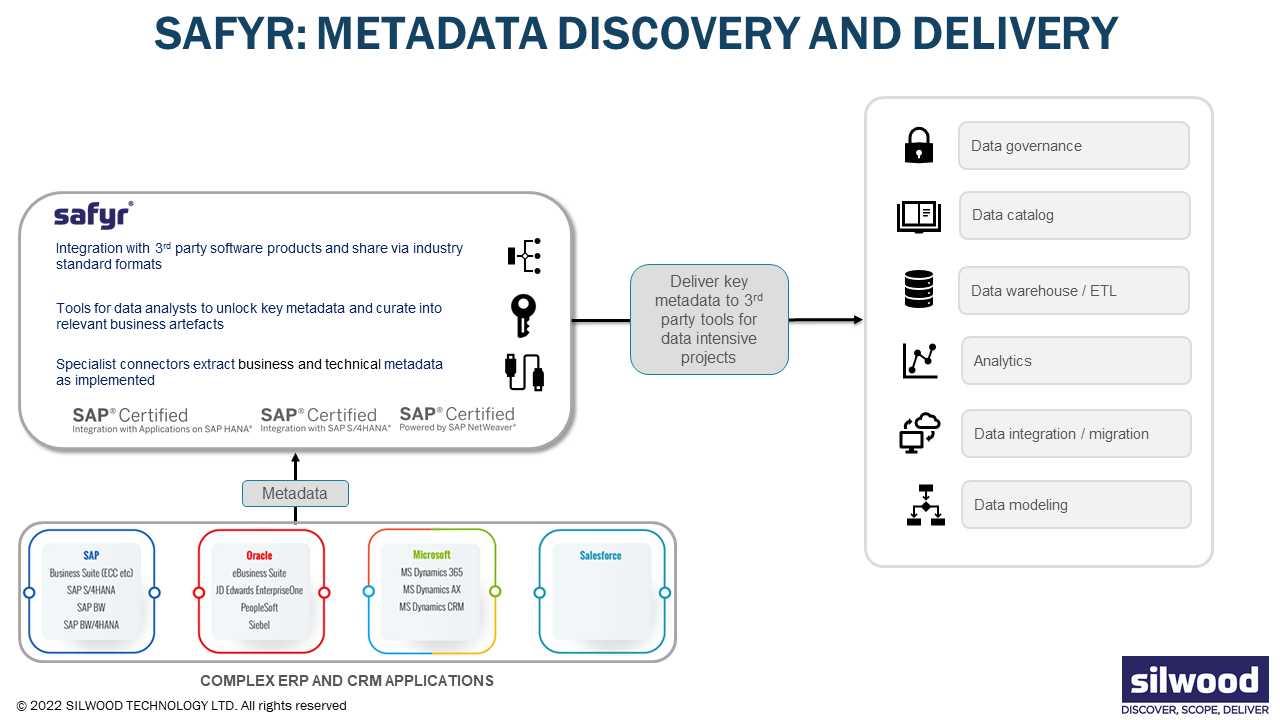
Bloor Research aptly summarized Safyr’s impact, stating:
“Understanding complex ERP/CRM as a part of this process is non-trivial. Fortunately, Silwood’s aim has always been to hide the complexity of the underlying environment so that you don’t need detailed technical knowledge of your ERP/CRM deployment in order to reach this understanding.”
Real-World Success: Trusting Data with Safyr
Over the years, ERP customers have grappled with maximizing the potential of legacy applications. Safyr has emerged as a game changer, allowing businesses to self-service their needs in discovering, analyzing, and documenting their key systems. Bethany Bruns, Director of Data Governance at Henny Penny, shared her experience:
“We are currently going through an Enterprise Digital Transformation initiative and use JD Edwards as our ERP.
Bethany Bruns Director of Data Governance, Henny Penny
We have begun efforts to assess the current state of particular areas of our data and have used Safyr to help us understand the intended purpose of certain fields in the system and compare that to how they are being used or misused in the system. This will help us to identify areas of opportunity to better leverage the system as intended.
We plan to leverage the data models and pull those into our integrated data modeling tool once we begin to design a data warehouse in the upcoming year. We have had a very positive experience working with the Safyr team thus far and look forward to working with them more as we begin to further leverage their tool in the upcoming months.”
Indeed, trust begins with shedding light on all available evidence. In the data-driven world we inhabit, this trust is not just a luxury but a necessity.
Conclusion
As businesses navigate a complex and data-rich landscape, trusting your data is no longer optional—it’s imperative. The challenges posed by ERPs and complex data models are met head-on by innovative solutions like Safyr. By leveraging metadata and data lineage, businesses can instil trust in their data, empowering them to make informed decisions, maintain compliance, and thrive in a competitive environment. Trust in data is not just a goal; it’s the key to unlocking your business’s full potential.
 Data Quality Matters
Leave a comment