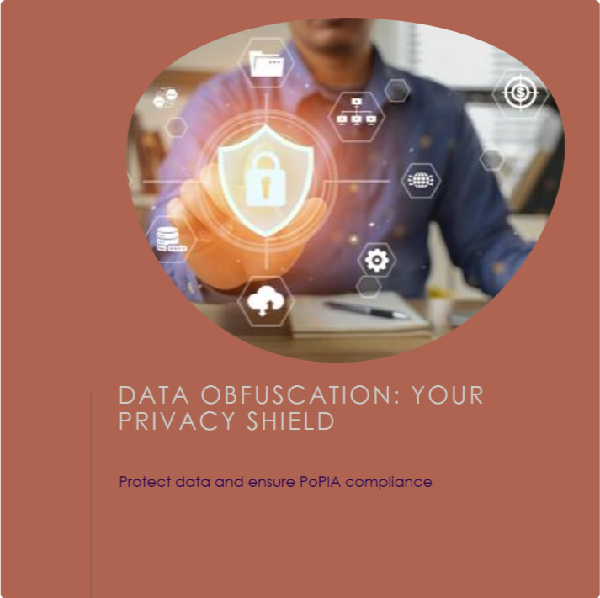
In today’s connected economy, data breaches aren’t just headlines; they’re costly, reputation-shattering realities. Organizations entrusted with personal information – especially sensitive identifiers under South Africa’s Protection of Personal Information Act (PoPIA) – face immense pressure to protect it. While firewalls and access controls are essential, there’s a powerful, often underutilized strategy crucial for true privacy and compliance: Data Obfuscation.
- What Exactly is Data Obfuscation?
- How Does Obfuscation Work? Common Techniques:
- Why is Obfuscation a Privacy & PoPIA Compliance Imperative?
- Getting Started with Data Obfuscation for PoPIA Compliance:
- Conclusion: Obfuscation is Non-Negotiable for Modern Privacy
What Exactly is Data Obfuscation?
Think of it as data disguise. Data obfuscation is the intentional process of altering or disguising sensitive information to render it unusable or unintelligible to unauthorized individuals, while preserving its core structure and usability for legitimate business purposes.
The goal is simple yet profound: if unauthorized access occurs (through a breach, human error, or even internal misuse), the exposed data is meaningless gibberish to the attacker, significantly reducing the harm and potential regulatory fallout. Your real customer data remains safe.
How Does Obfuscation Work? Common Techniques:
- Data Masking: Replacing real data with realistic but fictional data, or disguising data displayed to a user. Imagine replacing “John Doe” with “Mark Smith” or “ID 8001015009087” with “ID 9002124008085”. Perfect for development, testing, or training environments where real data isn’t needed. (e.g., A call center uses masked customer records for agent training.)
- Encryption: Transforming data into a complex, coded format using an algorithm and cryptographic key. Only those possessing the correct key can decrypt and read the original data. Essential for protecting data “at rest” (in databases) and “in transit” (over networks). (e.g., Encrypting customer credit card numbers stored in your database.)
- Tokenization: Swapping sensitive data (like a credit card number) with a randomly generated, non-sensitive placeholder called a “token.” The token has no mathematical relationship to the original data and is useless outside the specific, secure tokenization system. Often used in payment processing. *(e.g., Storing a token “TKN-76F3GH” instead of the actual card number “4111 1111 1111 1111”.)*
- Anonymization: Permanently stripping data of all elements that could identify an individual, making it impossible (or extremely difficult) to link the data back to a specific person. This is often irreversible. (e.g., Aggregating and stripping location/GPS data from fitness app users for broad trend analysis.)
- Pseudonymization: Replacing identifying fields within data with artificial identifiers (pseudonyms). While the individual records are obscured, it’s reversible under controlled conditions (using separately stored “key” data). (e.g., Replacing customer names and IDs with unique codes in an analytics dataset, where the mapping key is held securely by the IT department.)
Why is Obfuscation a Privacy & PoPIA Compliance Imperative?
Forget just being a “nice-to-have.” Data obfuscation is increasingly recognized as a fundamental best practice for lawful processing, especially under stringent regulations like PoPIA. Here’s why:
- Directly Addresses PoPIA’s “Security Safeguards” (Section 19): PoPIA mandates that organizations implement appropriate, reasonable technical and organizational measures to prevent loss, damage, unauthorized destruction, or unlawful access to personal information. Obfuscation is a powerful technical control that renders data useless if breached, directly fulfilling this requirement.
- Enables “Processing Limitation” (Section 9): PoPIA requires that data collection and processing be adequate, relevant, and not excessive. Obfuscation allows you to use only the minimally necessary identifiable data for a specific task. For example, developers testing a new feature don’t need real customer IDs and names; masked data suffices.
- Mitigates Breach Impact & Notification Burden (Section 22): If a breach does occur involving properly obfuscated data (especially anonymized or strongly pseudonymized data), the risk to data subjects is drastically reduced. This can significantly lower the likelihood of harm and may even influence whether the breach is deemed reportable to the Information Regulator and affected individuals under PoPIA’s strict breach notification rules.
- Supports “Purpose Specification” (Section 13): By using obfuscated data for secondary purposes (like analytics or testing), you ensure that the data used aligns only with the purpose for which it was obfuscated, not its original collection purpose, enhancing compliance.
- Reduces Overall Risk Profile: Obfuscation shrinks the “attack surface” of valuable sensitive data within your environment. Less exposed sensitive data means less attractive targets and lower potential fines/penalties in case of incidents – a core PoPIA principle (Accountability).
- Facilitates Safe Data Sharing & Collaboration: Need to share data with a third-party vendor, partner, or even an internal analytics team? Obfuscation allows you to share valuable datasets for legitimate business purposes without exposing the raw, sensitive PII, maintaining trust and compliance.
- Maintains Data Utility: Crucially, unlike simply deleting data, obfuscation preserves the format and statistical properties of the data. This allows developers, testers, and analysts to work with realistic data without compromising individual privacy or violating PoPIA.
Getting Started with Data Obfuscation for PoPIA Compliance:
- Identify & Classify: Know where your sensitive PoPIA-regulated data (especially Special Personal Information) resides. Map its flow through your systems. Classification is key.
- Assess Use Cases: Determine why different roles or processes need access to data. Do they need real identifiers, or will masked/pseudonymized data suffice?
- Choose the Right Technique(s): Match the technique to the sensitivity and the purpose. Use strong encryption for data at rest/in transit. Leverage static masking for non-production environments and dynamic masking for production. Consider pseudonymization for analytics where reversibility might be needed later. Favor irreversible anonymization where possible.
- Implement Robustly: Ensure token vaults, encryption key management, and mapping tables for pseudonymization are themselves highly secure.
- Integrate into Processes: Make obfuscation a standard part of your development lifecycle (DevSecOps), testing procedures, and data sharing agreements.
- Document & Audit: Clearly document your obfuscation policies, techniques used, and access controls. Regularly audit effectiveness.
Conclusion: Obfuscation is Non-Negotiable for Modern Privacy
In the fight to protect personal information and achieve PoPIA compliance, data obfuscation is far more than a technical trick. It’s a strategic shield.
By deliberately disguising sensitive data while retaining its utility, organizations significantly reduce privacy risks, mitigate the impact of potential breaches, and demonstrate a proactive commitment to the core principles of PoPIA – minimizing harm and processing data responsibly.
Don’t just lock your data away; disguise it intelligently. Make data obfuscation an integral part of your privacy and security posture today. Your customers’ trust and your regulatory standing depend on it.
Disclaimer: This blog post provides general information and should not be construed as legal advice.
 Data Quality Matters
Leave a comment