When it comes to analyzing information to detect trends and patterns that can impact various facets of business, a host of different areas and specialists can be involved – data scientists, financial analysts, marketing analysts, logisticians, and computer systems analysts, to name a few. They need full visibility into the organization’s data. What challenges do they face in accessing and utilizing data for Business Intelligence (BI)?

Ready to upgrade your data analysis capabilities? Our guide on Business Intelligence Tools can help you choose the right tools for your needs
Business Intelligence and the Data Challenge
As its name suggests, business intelligence (BI) is about using data to make intelligent business decisions. In today’s complex, data-rich business environments, BI is the “it” factor that can turn an organization’s data into a competitive edge, driving digital transformation and strategy formation for informed decision-making.
This requires the monitoring, collecting, and reporting of copious amounts of data for BI analysis. The sheer volume of data and the complexity of the environments through which it flows make the roles of data management, data science, and BI analysis even more challenging.
Data analysts and BI analysts are on the frontlines, navigating database management systems, mining and analyzing data, and preparing data visualizations and models. However, the challenges they face can hinder the effectiveness of BI efforts:
- Disparate Data Sources: Disparate databases, data systems, and reporting and analysis tools that lack integration. These systems and tools can’t communicate with each other, so data movement and dependencies are unseen and lost in translation.
- Lack of Collaboration: Disparate business units and teams with different approaches, tools, and goals for data analytics. These various teams may need the same data and rely on the same systems, but the humans aren’t communicating with each other or collaborating in how they access and analyze the data.
- Data Quality: Questionable data quality. Data from disparate sources and systems can lead to oversights and data blind spots, corrupted data, and all-around “messy data.” If you can’t trust your data, you can’t use it for informed decision-making.
- Spreadsheets: Manually entering and tracking data information and flows within a spreadsheet is a drain on man-hours—hours the team could be using to analyze and optimize data for BI efforts, rather than chasing down data and organizing spreadsheets.
The Solution: Data Lineage
To address these challenges, organizations are turning to data lineage. Data lineage provides a clear view of how data flows through an organization’s environment, from creation to consumption. It maps dependencies between data entities, allowing organizations to tame data complexity and optimize it for BI efforts.
How Automated Data Lineage Helps BI Efforts
Here’s how data lineage can help organizations overcome the challenges associated with BI:
- Comprehensive Data View: Data lineage shows all the paths data takes through an organization’s environment, combining various datasets, streams, and flows for a more manageable view of data sources.
- Revealing Connections: It reveals connections between workspaces, systems, and data objects, eliminating surprises or blind spots.
- Historical Lineage: Data lineage can detect previous revisions and changes in the data environment (historical lineage), allowing analysts to understand past states and their impact on the current data landscape.
- Data Importance: It highlights which data is essential, showing the effects of change and which datasets will be impacted.
- Time and Resource Savings: By automatically scanning and mapping the data environment, automated data lineage frees BI analysts to focus on generating insights for informed decision-making rather than spending time on data management tasks.
In short, by having visibility into the entire journey of the organization’s data, BI teams have the complete data picture they need to interpret it effectively for informed decision-making.
MANTA Automated Data Lineage for BI
MANTA’s automated data lineage platform offers a robust solution for organizations seeking to enhance their BI efforts. Here are some key features:
Historical Lineage and Time Slicing
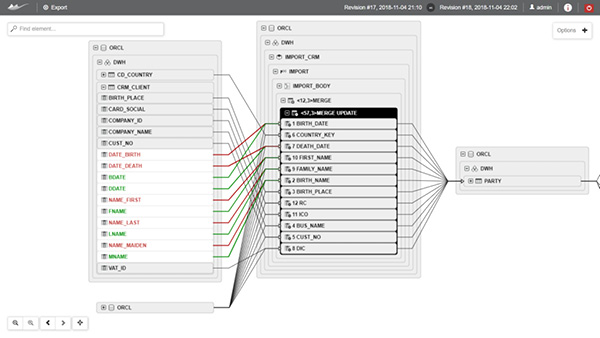
Establishing a plan for delivering historical lineage ensures BI teams have a complete picture of the data lifecycle to successfully analyze the data journey. MANTA’s Revisions feature allows you to compare different “time slices” to see how lineage has developed over time.
Data Transformation and Active Tags
Data in today’s enterprises undergoes transformations across multiple touchpoints, such as data warehousing, data migration, and integration. Data transformation is crucial for the data visualization, reporting, and analysis needed in BI. MANTA’s automated data lineage can help ensure data quality and provide insights and support for data transformation by identifying and highlighting transformations with MANTA Active Tags.

MANTA Supported Scanners
MANTA’s code-level scanners automatically harvest data transformation logic from over 45 sources, from BI and reporting tools to data integration platforms, to common data sources including:
- Snowflake: Maps lineage for a comprehensive overview of the data journey and lifecycle to understand data in context, increase business agility, and deliver data intelligence that fuels growth.
- Google BigQuery: Connects to this serverless, highly scalable data warehouse to scan metadata and read SQL programming code and logic to create a detailed visualization of data lineage.
- Microsoft Excel: Processes files and looks up objects (e.g., graphs and pivot tables), with all mapped objects connected with their source objects by analyzing queries with MANTA’s database connectors.
- Qlik Sense: Extracts metadata for data flow analysis, processes essential Load Script statements to define how data is loaded and transformed, and analyzes the usage of the data loaded from physical data sources in visualizations used in the applications’ sheets.
- Tableau: Connects to Tableau Online and Tableau Server to automatically extract all workbooks and data sources and pushes data lineage visualization to various platforms, optimizing Tableau as an end-to-end data-visualization reporting tool that simplifies data for actionable BI insights.
- SAS: Connect to SAS models and analyses SAS scripts, database connections and user defined functions and procedures
- Power BI: Scans reports, datasets, and database connections for data lineage visualization, amplifying Power BI’s capabilities in providing interactive data visualizations for data insights.
- Microsoft SQL Server Analytics Platform System: Connects to the on-premise data warehouse platform to scan metadata, reads all SQL programming code and logic stored in it, and creates a detailed visualization of the data lineage.
- Microsoft SQL Server Analysis Services: Extracts lineage from the SSAS analytical engine to create the most precise end-to-end data lineage for this analytics platform for greater capabilities and control in creating reports.
- Microsoft SQL Server Reporting Services: Processes reports to create the most precise end-to-end data lineage for this highest layer of the Microsoft business intelligence environment.
These are just a few of MANTA’s natively supported scanners. See the complete list encompassing databases, ETL tools, reporting and analysis software, modelling tools, and programming languages.
Conclusion
In the era of data-driven decision-making, having a comprehensive view of your data landscape is paramount. Data lineage provides the missing link, offering transparency into data flows, dependencies, and transformations. By investing in data lineage solutions like MANTA’s automated platform, organizations can supercharge their BI efforts, unlocking the true potential of their data assets and gaining a competitive edge in today’s data-rich business environment.
A Data Catalog can streamline your BI efforts. Learn how with our guide
Understand why data lineage is becoming urgent to meet the needs of modern businesses.
This post was first published by MANTA, on their blog, and is reposted with permission.
Image from unsplash
 Data Quality Matters
Leave a comment