In today’s data-driven world, it is essential to ensure that the information we use is of the highest quality so that we don’t miss the target.
Discover effective strategies and best practices to overcome the hurdles of BI deployment and usage with insights from How to address the top challenges of BI, empowering your organization to unlock the full potential of data analytics.
However, many people often confuse the terms “data quality” and “information quality” and use them interchangeably. In this article, we aim to differentiate between these two concepts and shed light on the importance of each.
Data Quality, Data Integrity and Information Quality
Data quality refers to the degree to which data is accurate, complete, consistent, and timely. In other words, it is the quality of the raw data that is used to generate information. On the other hand, information quality refers to the degree to which information is accurate, relevant, timely, and actionable. In essence, it is the quality of the output generated from the raw data when used for a purpose. While data quality can be evaluated upon objective characteristics, information quality is more subjective, as it depends on context.
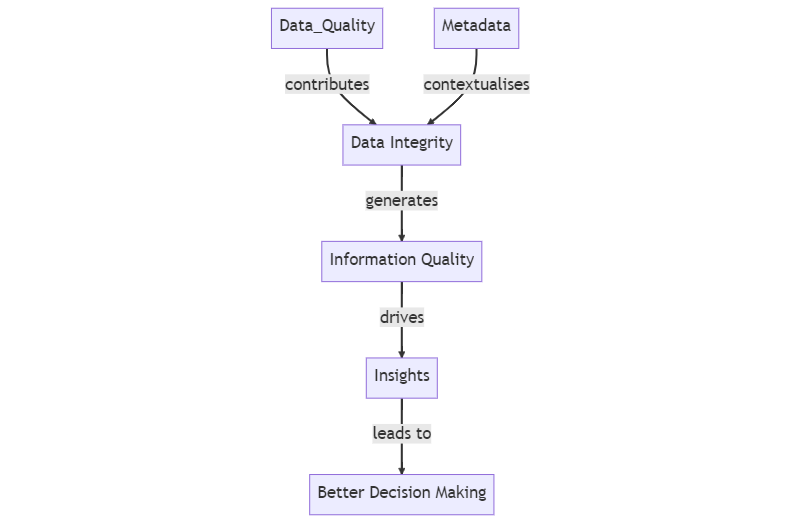
Data integrity fits somewhere in between. Data that has high integrity is free from errors and has business context, which means it is relevant and useful for its intended purpose. When data has high integrity, it contributes to information quality by ensuring that the insights generated from the data are accurate, relevant, and timely and that they have context.
To illustrate this concept, let’s consider an example:
Suppose a company collects customer data such as name, address, and email address. Data quality would ensure that this data is complete, accurate, and consistent across all the records. Adding business context, such as demographics, purchasing history and customer preferences builds data integrity, which, finally, generates information quality in the insights that can help the company personalize its marketing campaigns and improve customer engagement.
In addition, high data integrity also ensures that the insights generated from the data are consistent across different sources, which is essential in ensuring that decisions made from the insights are reliable and consistent.
Therefore, data integrity is a critical factor in ensuring high information quality, as it provides a solid foundation for generating insights that are relevant, accurate, and actionable for the organization.
Importance of Data Quality and Information Quality
The importance of data quality and information quality cannot be overstated. Poor data quality can result in incorrect information, which can lead to bad decisions, lost opportunities, and decreased productivity. For instance, if a company relies on inaccurate customer data, it may send marketing emails to the wrong audience, resulting in a low response rate and wasted resources.
Likewise, poor information quality can lead to incomplete or incorrect insights, leading to ineffective strategies and missed opportunities. For example, if a company generates reports based on incomplete or outdated data, it may miss out on trends, patterns, or opportunities that could have been identified with accurate information.
Data Quality and Information Quality Challenges
Ensuring high data quality and information quality comes with its challenges. One of the main challenges is the lack of data governance policies and processes. Without clear policies and processes, data can become siloed, duplicated, or inconsistent, resulting in poor data quality and information quality.
Another challenge is the lack of technology infrastructure to support data management and analysis. Without the right tools, it can be challenging to ensure data accuracy, completeness, and consistency. It can also be difficult to generate relevant and actionable insights from the data.
Conclusion
In conclusion, data quality and information quality are two distinct but interrelated concepts that are essential in today’s data-driven world. While data quality ensures that the raw data is accurate, complete, consistent, and timely, information quality ensures that the output generated from the data is accurate, relevant, timely, and actionable. Ensuring high data quality and information quality comes with its challenges, but with the right policies, processes, and technology infrastructure, organizations can achieve optimal results.
We hope that this article has been informative and has helped you differentiate between data quality and information quality.
Understand the reasons behind the disconnect between business objectives and data analytics teams with insights from BARC Research Reinforces Disconnect Between Business and Data & Analytics: Confidence in Data Integrity, fostering collaboration and alignment for better outcomes.
Streamline the process of delivering BI reports with practical tips and strategies outlined in how to make delivering a BI report quicker and easier, optimizing efficiency and effectiveness.
If you have any questions or would like to learn more about how we can help you with your data quality and information quality needs, please feel free to contact us.
FAQ
What is the difference between data and information?
Data and information are defined in reference to each other – information can be defined as data that is of high integrity i.e. it is data that has context, as well as being accurate, complete and fit for purpose.


Leave a Reply