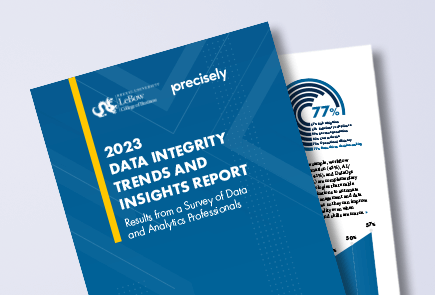
Groundbreaking findings from the 2023 Data Integrity Trends and Insights Report uncover the pervasive issue of poor data quality across organizations.
A staggering 70% of respondents lack trust in their data, pointing to data quality as their most significant challenge in making confident decisions.
Discover practical approaches to empower decision-makers with insights from How to Empower Decision Makers,
Disconnected objectives
The findings shed light on a concerning disconnect. A striking 77% of professionals surveyed prioritize data-driven decision-making as their primary objective for data programs in 2023. This objective is closely followed by the aspirations to enhance operational efficiency (73%), reduce costs (62%), generate revenue (59%), and improve regulatory compliance (57%)—all reliant on the foundation of trusted data for successful outcomes.
“Data leaders are being called upon more than ever to enable data-driven decision-making, which is fundamental to driving every one of the top business priorities identified by the research. The research provides a benchmark for organizations in their journey to data integrity — highlighting both pockets of progress and areas for continuous improvement and investment.”
Kevin Ruane, Chief Marketing Officer at Precisely
Dominance of Data Quality Issues in the Data Landscape
The study further illustrates the systemic impact of poor data quality, ranking it as the foremost obstacle to successful data integration programs (60%) and the most common barrier to the effective use of location intelligence (41%) for informed decision-making.
Murugan Anandarajan, PhD, Professor of Decision Sciences & MIS and Academic Director at the Center for Business Analytics at LeBow, emphasized, “With data quality cited as both the leading challenge and the leading priority in 2023, it’s not surprising that less than half of respondents (46%) rated trust in their data as ‘high’”’ or ‘“’very high’”
Moreover, more than half of the respondents (53%) identified data quality as their top priority for ensuring the integrity of their data. Additionally, a staggering 71% reported that their organizations spend 25% or more of their work time preparing data for reporting and decision-making—an expensive consequence of poor data quality.
Data Priorities Driven by Need for Business Agility
Organizations are re-evaluating their data strategies due to macroeconomic impacts.
Staffing and resource reductions (40%) and budget cuts (37%) have prompted businesses to turn to technology for increased flexibility and cost reduction. Over half of the surveyed data leaders (57%) confirmed the migration of workloads to the cloud, and a significant portion (42%) reported ongoing digital transformation within their organizations.
To enable data management and processes, organizations are deploying complementary technologies such as workflow automation (43%), artificial intelligence (AI) and machine learning (41%), and DataOps (30%). These technologies not only address widespread data integrity issues but also mitigate challenges posed by limited human resources and skills.
“These technologies raise the stakes on the need for data integrity — data that is accurate, consistent and contextual to the business purpose,” added Ruane. “If you’re feeding bad data into these automated scenarios, you’re going to get worse outcomes.”
Understand how data quality enhances Business Intelligence (BI) effectiveness by delving into insights from How Data Quality Makes BI Better, showcasing the crucial role of data integrity in improving analytical outcomes.
For more insights from the research findings and to delve deeper into the data, watch the State of the Industry Panel from this year’s Precisely Trust ’23 event, featuring Precisely CEO Josh Rogers, Kevin Ruane, and the LeBow team and access the complete 2023 Data Integrity Trends and Insights Report for a comprehensive analysis.
Learn how to leverage data quality to enhance business processes with insights from How to Use Data Quality to Improve Business Processes, highlighting the transformative impact of reliable data on operational efficiency.


Leave a Reply